Question:What diagnostic options are available to for example in an Eelectric wave application in the master and slave to be able to carry out a reaction such as the quick stop (QSP) very quickly?
How is this implemented in i950 TAs?
Answer:
When the EtherCAT onboard is used as a system bus to transmit position and speed control values, it is often necessaryrto react very quickly to communication errors in the master and slave .
i950 as EtherCAT master:
An i950 PLC is required to detect a communication interruption.
In the case of an i950 TA, the appropriate project template must be used.
The parameter <Axis_Ref>.xCommunicationOK should under no circumstances be used for recognition with these devices.
It can take between 30-100ms for the status of this parameter to change.
Instead, the state should be set via the property ETCSlave.WcState can be monitored
The WorkingCounterState can be used to detect in the master if the actual counter value deviates from the expected value. This can be used to detect whether there is a restriction in communication with one of the slaves. This happens very quickly, but it is not possible to distinguish which slaves can still be communicated with and which cannot.
WcState is a Boolean status: TRUE = deviation detected in the WorkingCounter.
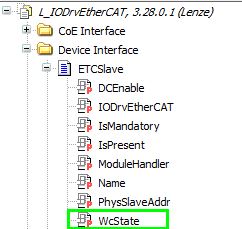
Example of the WcState implementation. This property only needs to be queried for one of the EtherCAT devices, as the value is always identical for all devices (TRUE or FALSE).
i950 as EtherCAT slave:
In system bus slave a communication interruption of the 'PDO telegram failure detection for DC', a monitoring function of the i950 firmware detected.
The sensitivity of this monitoring is adjustable. With the default setting Sync error counter limit 0x10F1:2 = 20 six missing telegrams are tolerated.
With 0x10F1:2 = 1 or 2, an error 0x8181 (EtherCAT communication error) is reported for the first missing telegram.
The transition response is in 0x605E (CiA: Response to minor faults) adjustable. By default with 0x605E = -2 (Advanced quick stop) is used with Quick stop deceleration 0x6085:0 stopped. 'Advanced' means in this context that in the case of a motor failure if no Servo control is no longer possible, a brake torque by short-circuit braking (SM) or DC braking with ASM is applied.
If the standstill is detected or the time monitoring for the error response 0x2826:0 has expired, then will automatically switch to the error state and the power section will be disabled.
The monitoring function cannot be switched off. It could merely increase the response time with an increase of 0x10F1:2 or it can be increased above 0x605E:0 = 0 instead of reacting with a quick stop directly switch to the error state.
With 0x10F1:2 = 1 or 2 to not allow missing telegrams is rather impractical, because otherwise singular errors can lead to an unexpected error stop.If singular errors are tolerated, setpoint extrapolation must be used to prevent setpoint jumps from occurring.
For dynamic applications, a value of 3 or 6 is recommended for 0x10F1:2. This results in an error response after 1 or 2 telegram failures.
For non-dynamic applications, the set value (20) can be retained.
From i950 FW1.9.0:
In the event of a telegram failure, the position is extrapolated further until the set number of telegram failures is reached. This is controlled internally via the variable xSyncProcessDataValid of the onBoardEtherCAT achieved.