Remedied as of:
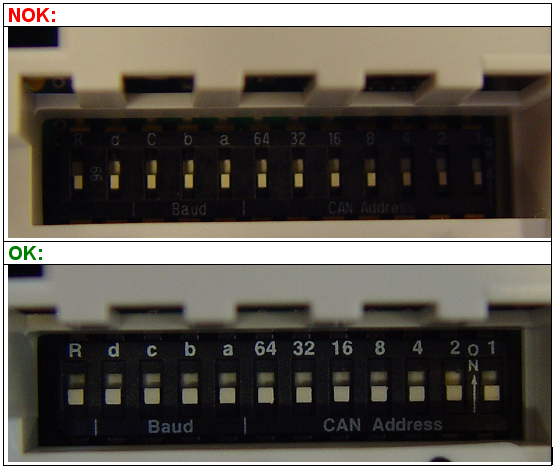
8400 StateLine, HighLine by using a different DIP switch, see photo.
Behaviour of the new version?
CAN bus can be properly terminated. DIP switch contacting is perfect.
Which products are concerned?
8400 StateLine, HighLine manufactured in a specific production period
What happens?
The faulty contacting of DIP switch S1 (R) on the CAN DIP switch may lead to a faulty CAN bus termination. The correct function of the CAN terminating resistor via the DIP switch cannot be ensured.
When does the problem occur?
The problem occurs with devices connected at the end of a CAN line for which the terminating resistor is activated in the inverter (R) for the CAN bus.
Possible diagnostics?
When the activated terminating resistor between CAN HIGH and CAN LOW is measured, a resistance of 120 Ohm must be measurable per termination. If the measured resistance is well above 120 Ohm, it is likely that a fault has occurred.
In the following picture you can see the switch type concerned (photo on top) and the correct switch type (photo at the bottom).
Short-term measures/recommendations?
As a short-term measure, the CAN bus can be terminated via the terminals CAN HIGH (CH) and CAN LOW (CL) at inverter terminal X1. A commercial 120-Ohm resistor (E24 series) can be used to terminate the bus.
Assessment:
The problem only occurs with devices connected at the end of the CAN line which are used to terminate the end of the line.
Check the CAN bus and the correct function/termination of the CAN bus during commissioning.
In the following Excel table, the serial numbers (material number + serial number) of the control cards concerned are listed. They can e. g. be read out via code C0204, subindex 1. (An identification via the device nameplate is not possible).
List of devices concerned