Universal current-sensitive residual current protective devices (RCD, FI), type B or type B+ during drive controller operation, leakage current

Question:
Why do universal current-sensitive residual current protective devices (RCD) of type B and type B+ have different tripping times when they are operated in connection with drive controllers?

Answer:
In certain applications, the use of RCDs is prescribed by standards and regulations. In practical operation, only universal current-sensitive residual-current protective devices (RCD) of type B or B+ are used together with controllers. Universal current-sensitive RCDs are prescribed whenever DC fault currents may occur. Since type A RCDs only respond to AC and pulse current components, they do, according to the applicable standards and regulations, not provide an appropriate protection for controllers with 3-phase mains supply. The relevant standards and regulations may differ from country to country.

Universal current-sensitive RCDs that respond to AC, pulse, and DC fault currents are referred to as type B RCDs. Since some time, there have also been RCDs of type B+ available.
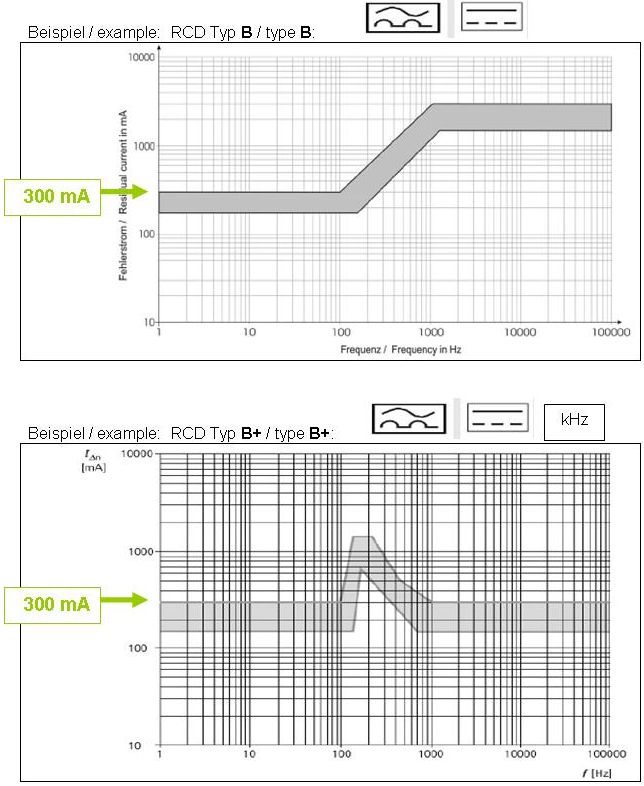
Both types only differ in the tripping characteristics for higher-frequency fault currents, see the attached frequency response diagrams:
  • Type B is less sensitive to higher-frequency fault currents. The tripping threshold for higher frequencies is well above the rated RCD current. During controller operation, there occur higher-frequency fault currents (leakage currents) which thus will not that quickly reach the tripping threshold.
    Type B RCDs will do to meet the requirements during operation of electrical equipment that can cause a steady component in the residual current.
  • With type B+, the tripping threshold is even in the upper frequency range only as high as the rated current.
    Type B+ is used to reach a high fire protection. On the other hand, this type B+ is more sensitive during controller operation and trips comparatively earlier. 
    Therefore, Lenze controllers can usually not be operated together with type B+ RCDs.
  • For clarification: Type B+ must not be regarded as successor of type B. According to the standard, both RCD types (B and B+) are available for applications. 
    The use of tpye B+ RCDs could possibly be prescribed by special fire protection regulations for areas particularly sensitive to fire hazards.  

Standards, status 2019:  EN 60947-2; VDE 0664-400:2012-05; VDE 0664-401:2012-05

Important for dimensioning:
To avoid false trippings of RCDs, there should be appropriate safety reserves available. For this reason, we recommend to select the tripping / rated current of the RCD three times higher than the leakage currents occurring during controller operation. Or, the other way round, the leakage current should only be 1/3 of the rated RCD current. According to the standard, RCDs may already trip from 50% of the rated current on; i.e. a 300 mA RCD can already respond from 150 mA on.

More information and measured values:

  • Consequences of the leakage currents on the application of an earth leakage circuit breaker in case of 9400 - see contribution with doc-ID 200607328
  • Leakage current of inverter drive 8400 (0.25..22.0 kW) BaseLine, StateLine, HighLine - see contribution with doc-ID 200800787
  • Leakage current of 8200 motec M4 - see contribution with doc-ID 200500624
  • Residual current protective devices (RCD) and electrical controllers - Leitfaden des ZVEI (ZVEI guidelines) - see contribution with doc-ID 201005459 (only available in German)


URL for linking this AKB article: https://www.lenze.com/en-de/go/akb/201005329/1/
Contact form