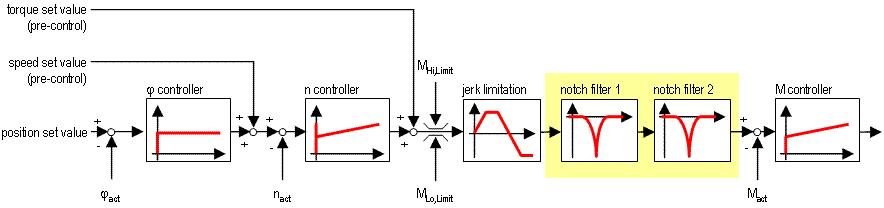
Notch filter: Operating principle and possible settings via C270/x, C271/x and C272/x
Question: Unlike the 9300 and ECS servo controller series, the servo controllers of the 9400 series allow you to filter out fixed parasitic frequencies by using notch filters (current setpoint filters) and, as a result, to clearly optimise the connected control circuits (speed controller/position/phase controller) once again. How do the notch filters work and what must be observed when using notch filters?
Answer: The current setpoint filters (2nd-order filters) influence the torque setpoint and allow you to hide parasitic frequency components. In addition to the product documentation, the attached PDF document provides detailed information on the operating principle of notch filters and illustrates the use of notch filters by means of an application example. Finally, the limits and restrictions for the use of current setpoint filters are described. The attached EXCEL file can be used to display the amplitude and frequency response in the Bode plot as a function of the parameter values C00270/x, C00271/x and C00272/x.