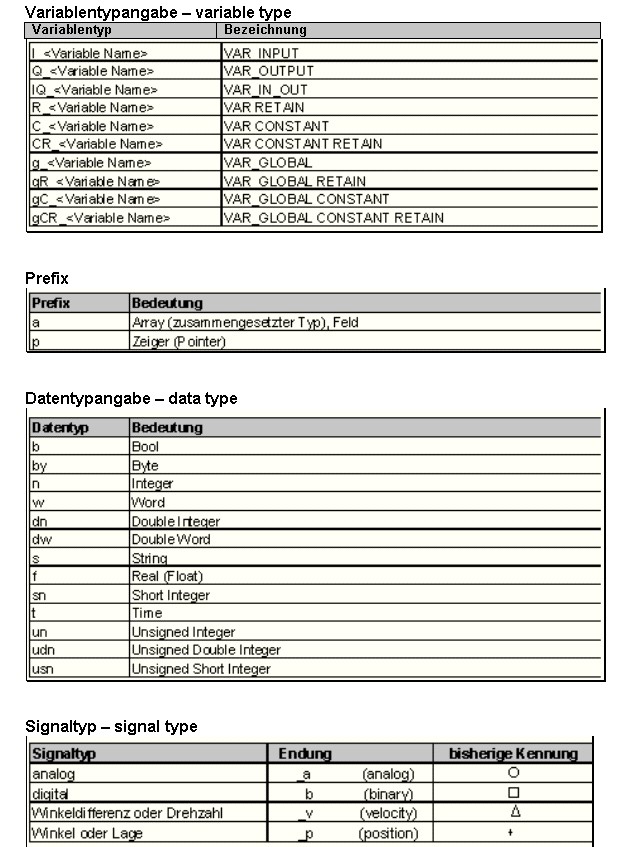
Which are the general contents and abbreviations when variable names are created with regard to the Hungarian notation?
Answer:
Lenze software guideline for variable names:
For the convention of the creation of variable names Lenze considers the 'Hungarian notation', which has been extended specifically by Lenze.
When the user applies Lenze-specific functions/function blocks, it becomes obvious for him which data type e. g. has to be given to a function block and which data type is given back as output value.
Following the Hungarian Notation:
These conventions are used e. g. in order to see the most important variable features from its name.
Variable names consist of:
one variable type indication
one prefix (in case of array or pointer)
one data type indication
one identification (the name 'itself' should refer to the use)
Designation of the signal type (in case of inputs and outputs of the Lenze function blocks)
Example:g_anFixSetSpeedValue_a
(a global array of type Integer containing analog values and is called FixSetSpeedValue)
Remember:
_a (analog) - 16384 = 100 %
_v (velocity) - 16384 = 15000 rpm
_p (angle or position) - 65536 = one motor revolution