
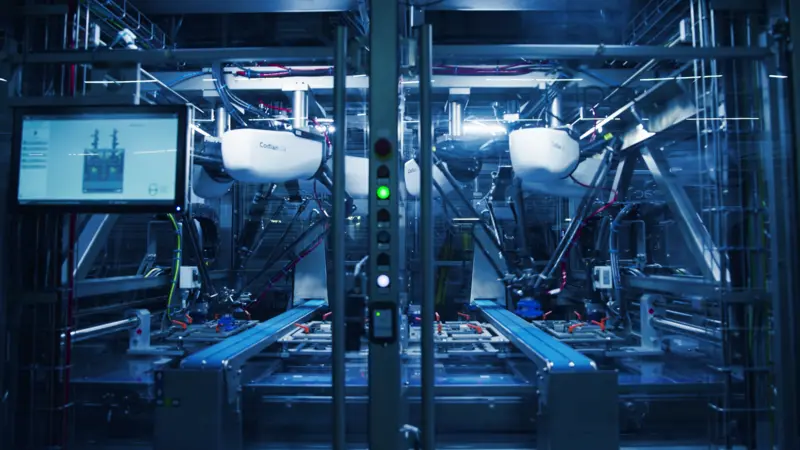
Mpac & Lenze develop scalable eight-robot packaging line
“The digital twin allowed us to validate our solution before the machine was built. That significantly reduced the risk for everyone involved.” With this conclusion, Berto Mathijssen, Technical Director at Mpac, sums up the essence of the joint project with Lenze.
Together, Mpac and Lenze developed a scalable multi-robot order-picking platform: The eight robots, distributed across four independent cells, each process more than 200 products per minute without affecting the line’s overall throughput. This is made possible by efficient material flow and high flexibility in the system—while simultaneously reducing downtime and significantly simplifying operation: product and recipe changes are quick and intuitive.

With the digital twin, we were able to validate our solution before the machine was even built. That significantly reduced risk for everyone involved.


Digital Twins as a key to success: From simulation to rapid commissioning
To demonstrate feasibility even before the actual plant construction began, Mpac and Lenze relied on a digital twin. This allowed them to simulate and validate process flows and performance requirements early on—long before the first component was manufactured. This significantly reduced project risks for all parties involved and had a direct impact on commissioning: Through virtual design, simulation, and validation, the production rate was increased from about one robot per week to three to four robots per week.
The effect was also evident in the timeline: for a system of this complexity, 18 months from inquiry to delivery is exceptionally short. This was made possible by thorough virtual preparation, which significantly facilitated the subsequent implementation. Robotics proved to be the key to transforming a complex mechanical challenge into a manageable, scalable solution.
