Brake test: Recommended reaction to detected angular drift
Question:
Why does a partially high motor current flow after detected angular drift despite closed brake and how can this be prevented?
Answer:
If the set 'Permissible angle of rotation' is exceeded during a brake test, the drive changes to the Fail-QSP state. However, the brake remains applied. Depending on the torsion of the motor shaft or even a short slip of the brake, a control deviation at the angle/speed controller can lead to a corresponding control value. The control may then work against the brake.
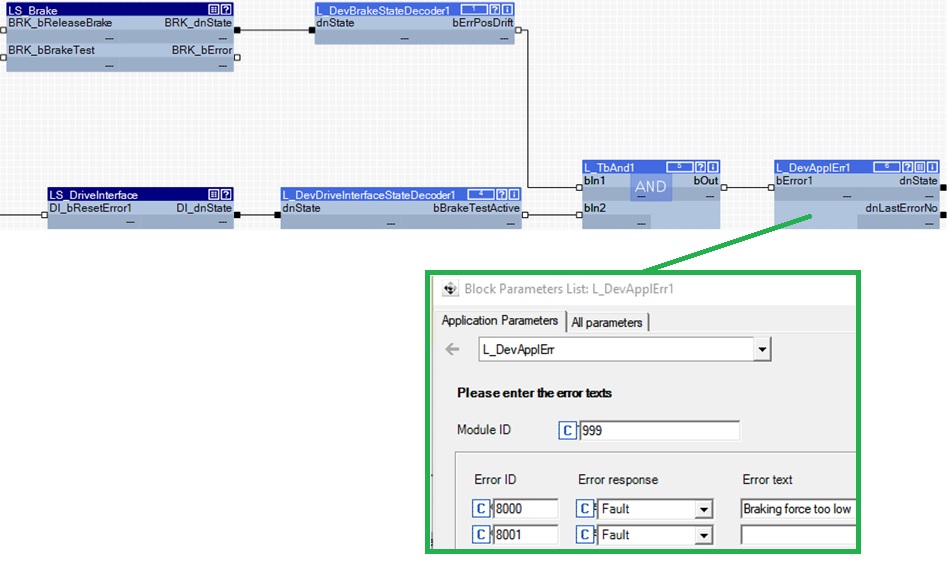
This can be prevented by a simple FB circuit in the 9400.
Since a brake test is typically carried out as a preventive measure in order to detect a weakening braking effect at an early stage, it can be assumed that the permissible angle of rotation was exceeded during the brake test with a higher torque than that which is at least required for operation. Therefore, as a reaction, the drive controller can be set to the 'error' state (inverter is blocked; the brake holds the active load) .
In order to detect this state 'Angular drift during brake test', the signals bErrPosDrift of the LDevBrakeStateDecoder1 are AND linked with the signal bBrakeTestActiv of the LDevDriveInterfaceStateDecoder1. The AND triggers an L_DevApplErr1. Error' is to be set as the error response. An error text can be freely selected. e.g.: Brake force insufficient.