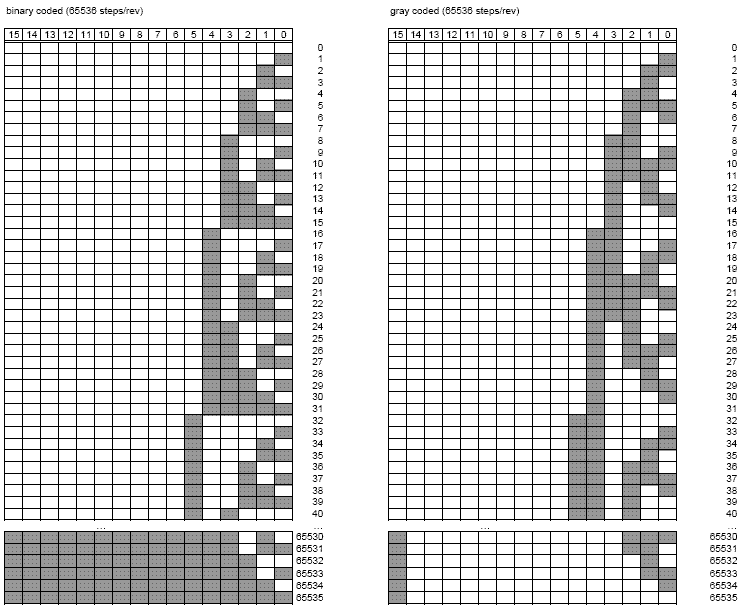
Question:
What is the difference between
binary code and
Gray code in case of absolute value encoders?
Answer:
In case of absolute value encoders the absolute position is always represented by a bit pattern with n Bits, in correspondence with n tracks of the absolute value encoder. The number of tracks (n) determines the resolution of the absolute value encoder.
Example: A single turn absolute value encoder with 16 tracks resolves an encoder revolution in 2^16 = 65536 steps. In order to be able to represent each single position from 0 to 65535 correctly, 16 Bit must internally be applied for presenting the position.
Common encoding types are
binary code and
Gray code:
Binary code: For presenting the positions the direct binary encoding of the absolute position value is used. According to the position value the states of one or several Bits modify from one value to another (see figure at the bottom left). Consequently, this encoding does not contain any safety aspect in the position check
Gray code: In case of the Gray code (which has its name from Frank Gray in 1946, scientist in the Bell Laboratories, see
http://en.wikipedia.org/wiki/Gray_code) a special encoding of the position values is used. The encoding is used in a way that from one position value to another the status of one single Bit is modified only. Consequently, this encoding contains an additional operating safety, as in case of simultaneous state change of two Bits an error must have been occurred when representing the position (see figure at the bottom right).