Cross-fade between setpoints

Question:
How can a 'non-rigid', but steady cross-fade with settable cross-fade times between two setpoints be realized?

Answer:
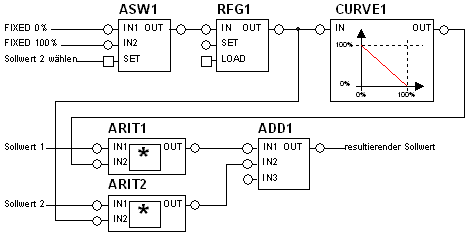
By means of function block switching both setpoints can be evaluated with an individual factor. For a cross-fade the evaluation factors for setpoint 1 (factor K1) and setpoint 2 (factor K2) are related as follows:

                 K2 = 100 % - K1

The dependency on K2 as a function of K1 can e. g. be represented by function block CURVE1.
As shown in the example the evaluation factor K1 can be modified from 0 % to 100 % or back by a ramp function generator RFG1.
The cross-fade times are set by means of the ramp times of the function block RFG1.
Operation with setpoint 1 or setpoint 2 is selected by means of the ASW1 function block (digital input signal at ASW1-SET).
Finally, the evaluated setpoints will be added by function block ADD1 and result in the setpoint.

Possible extensions:
  • The selector ASW1 can be set by any analog signal in order to reach a certain mixing ratio of the setpoint during the cross-fade.
  • If jerk-free cross-fades are required, the ramp function generator with S-ramps (function block SRFG1) can be applied instead of the linear ramp function generator  RFG1.
  • Instead of the ramp function generator the motor potentiometer function can be applied in order to set a mixing ratio of two setpoints by means of digital inching inputs.


URL for linking this AKB article: https://www.lenze.com/en-de/go/akb/200501769/1/
Contact form