Rotor position adjustment on Global Drive controller in combination with synchronous motor and STEGMANN absolute value encoders

Question:
When using synchronous motors the rotor position adjustment serves to identify the orientation of the magnetic field generated by the rotor in relation to the position signal returned by the absolute value encoder. Why is a rotor position adjustment required? According to which sequence is a rotor position adjustment executed in combination with synchronous servo motors and absolute value encoders at X8 (STEGMANN encoder with HIPERFACE interface)?

Answer:
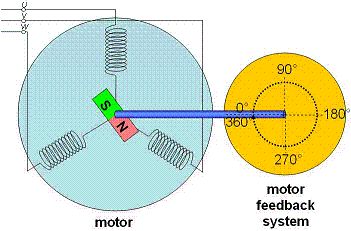
The graphics shows that a servo inverter (here stylised by a magnetic bar) can only move the rotor of the motor if the current can be injected in correct phase sequence into the windings U, V or W. This phase control can only be guaranteed if the servo inverter knows the position of the magnetic bar in the rotor through the feedback system. If the servo inverter does not know the position of the rotor, the servo inverter cannot optimally control the synchronous motor connected. As a result, torque reductions and even undefined balancing movements may occur when enabling the servo inverter.
The detailed rotor position adjustment is described in the attached pdf file.

Search term: PLI, pole position identification


URL for linking this AKB article: https://www.lenze.com/en-de/go/akb/200415295/1/
Contact form