Question:
Can variables be saved in the memory of the operating unit?
Answer:
Yes. When you define a variable in the project editor of the HMI designer select the entry
Lenze: Internal Registers in the
Device field.
The internal registers are a memory area within the operating unit. The size of the area depends on the selected operating unit. In this area variables of type
Word,
Dword,
String and
Bit can be saved.
The area of the internal registers is not protected against mains failure, just as operating units with back-up battery. This means, after mains disconnection of the operating unit the variables are initialised with the value 0 in the internal registers.
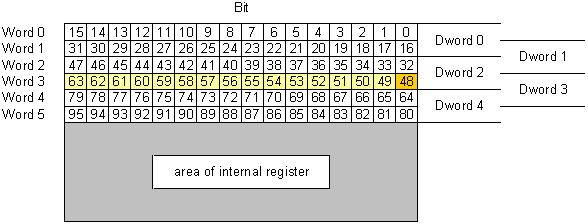
The internal registers are addressed word by word (
IR) or
bit by bit. Both addressing types access the same memory area.
Example: The word variable with address IR3 uses the least significant bit to access the same memory area as the variable with the bit address 48 (see figure).
If a variable of type
Dword is defined, this variable will assign the indicated register word (IR) and the next significant one.
Example: The Dword variable with the address IR2 assigns word 2 and 3, saving the more significant part of the variable in Word 2.
The HMI designer does not check the overlapping of variables in the internal register's memory area.