Relative positioning, behaviour after interruption caused by controller inhibit or failure

Question:
How does the 9300EP positioning controller behave after continuous applications have been disabled (relative positioning)?

Answer:
In  the positioning mode for continuous applications (C1210/000 = 'relative positioning') the position setpoint and the actual value each are reset by the value of the previous position target (TARGET) before a new positioning is started. This enables continuous operation, and the new positioning is always started at 0.0000 [units]. This procedure makes the drive always stop in the same angular position, provided that pre-positioning is made by exactly one revolution without letting the point drifting over the time, as the fluctuations of the actual value have no effect on the target calculations. When the start values are converted the current following error will remain, which ensures that there will be no jerks.

Concerning the behaviour after interruption there are two different cases in the relative positioning mode:

Case 1:  POS-IN-TARGET = High, interruption in standstill after the relative positioning has finished:

  • The drive is in position-target, e. g.: TARGET = 360 [units], SETPOS = 360 [units], ACTPOS = 360 [units]
  • The drive is inhibited (e. g. set terminal 28 to 0 V)
  • The drive is reset by e. g. 25 [units]: TARGET = 360 [units], SETPOS = 335 [units], ACTPOS = 335 [units]
  • The drive is re-enabled (e. g. set terminal 28 to 24V)
  • After an edge at the POS-PRG-START signal input the drive moves by the feed and the backwards distance: In the example this means that in case of a new relative position target TARGET(new) = 180 [units] the drive moves by the distance (TARGET(old) + TARGET(new) - SETPOS) = (360 [units] + 180 [units] - 335 [units]) = 205  [units]. Finally, the reference to the mechanics has been re-established - the drive is in initial position again.
  • If in contrast to the described example, the relative positioning is executed mot by 180 [units], but by 0 [units], only the backwards 25 [units] will be compensated.
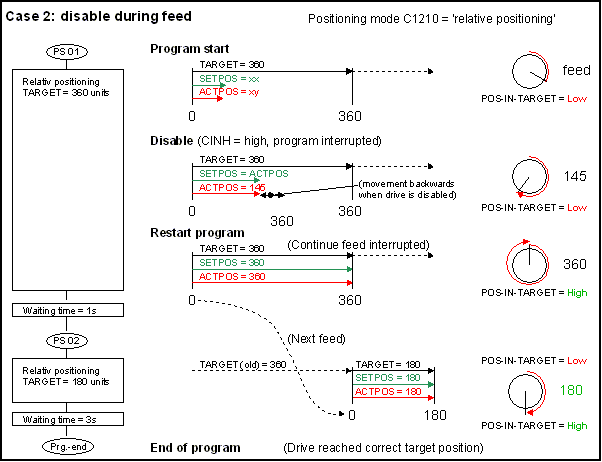
  • Case 2: POS-IN-TARGET = Low, disabled during positioning:

  • The drive has not finished the relative positioning yet. The position-target has not been reached yet, e. g. TARGET = 360 [units], SETPOS = 175 [units], ACTPOS = 170 [units]
  • The drive is inhibited (e. g. set terminal 28 to 0 V)
  • The drive is reset by e. g. 25 [units]: TARGET = 360 [units], SETPOS = 145 [units], ACTPOS = 145 [units]
  • The drive is re-enabled (e. g. set terminal 28 to 24 V)
  • After an edge at the POS-PRG-START signal input the interrupted positioning will be finished. The distance is calculated from (TARGET - SETPOS) = (360 [units] - 145 [units]) = 215 units. The reference to the mechanics remains - the drive is in initial position again.
  • Note:
    In both cases the reference to the mechanics remains, although the drive has moved in inhibited status. The procedure is the same, when the drive continues moving in feed direction. If the drive is moved over the target, a reset positioning can be the consequence or the next feed will be shorter.

    A disabled current positioning program leads to the drive's stop. This can have the following causes:

  • Controller inhibit
  • Quickstop (QSP)
  • Failure (Trip)
  • Failure (FAIL-QSP) or
  • Manual positioning (MANUAL-ACT).
  • The attached figures show the described cases.


    URL for linking this AKB article: https://www.lenze.com/en-de/go/akb/20039278/1/

    Further information

    Contact form