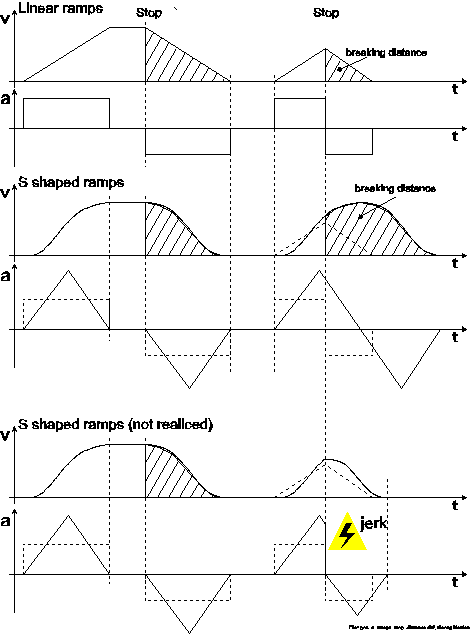
Positioning: S-ramps, length of brake path after stop signal

Question:
How does the brake path of S-ramps change if the stop signal is given during acceleration?

Answer:
In the S-ramp profile generator the brake path increases compared to stopping from constant speed if the stop signal is given during the acceleration ramp; i.e. if the available acceleration value is not equal to zero.

Influence of the jerk time
In a linear profile generator a sudden change from acceleration to deceleration is possible.
In an S-ramp function however, acceleration and deceleration are changed via a ramp (jerk time) to avoid jerking (see diagram). The acceleration not equal to zero in an S profile must first be reduced before the deceleration can start. In the phase of reducing acceleration the speed still increases and an additional distance is covered, despite the stop signal. The deceleration starts from a higher speed which means that the brake path will even more increase (see diagram).

Further special featurs of S-ramps:
  • If S-ramps are to achieve the same positioning time as linear ramps the peak acceleration must have the twice the value of the linear profile (see diagram).
  • Stopping during lower inital speeds results in longer positioning  times compared to linear ramps if the acceleration cannot rise sufficiently because of the preset jerk time.
  • This effect can be observed particularly during manual positioning with S-ramp as 'inert' drive behaviour.

This basic fact concerning the required brake path must be considered particularly when the mechanics is designed, to avoid crashes.

Diagram:
The characteristic of speed and acceleration as well as the suitable brake path as area in the v-t diagram for linear and S-ramps are shown.
The characteristics below show that an immediate braking in the acceleration phase is not possible for S-ramps if unwanted jerks are to be avoided.

URL for linking this AKB article: https://www.lenze.com/en-de/go/akb/20038668/1/
Contact form