 Which products are affected?
ESP-SP-POS - Software Package Positioner V3.1
What happens?
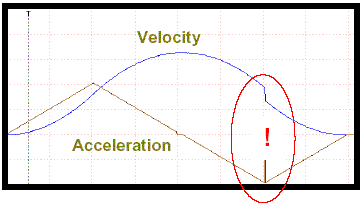
With very large jerk times, setpoint steps occur during the deceleration phase on profiles with jerk reduction.
When does the problem occur?
With jerk reduction the setpoint for the acceleration is increased and reduced linearly. The acceleration set in the parameters for the related profile is only achieved after the jerk time has elapsed. If the maximum acceleration cannot be achieved with the jerk time set, then the setpoint steps described occur during the deceleration phase.
Possible diagnostics?
This problem occurs in profiles in which the relationship between the jerk time set in the parameters and the actual acceleration time or deceleration time is not plausible. The jerk time is then only plausible if, within the acceleration time for a profile, the acceleration set in the parameters can be built up and reduced linearly within the jerk time. The times for the acceleration and deceleration can be determined by calculation or using the ProfileView function in the graphic user interface for the Positioner template.
Short-term measures/recommendations?
The jerk time for a profile must always be less than half the time determined for the acceleration or deceleration in the profile.
Evaluation:
If plausible jerk times are entered, no setpoint steps occur in the jerk reduced profiles.
The possibility of changing the acceleration, deceleration and velocity profile parameters with an override during positioning makes it more difficult to calculate the profile parameters to be entered so that jerk reduction is permissible.