 Which products are affected?
ESP-SP-POS - Software Package Positioner V3.1
What happens?
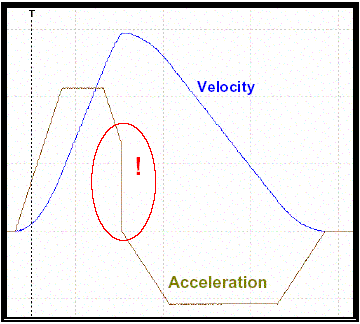
Profile shapes in which no constant positioning phase is attained result in acceleration steps as occur in linear velocity curves. After reaching the maximum possible velocity, the profile shape then no longer follows the required limited jerk curve.
When does the problem occur?
Profiles in which the resulting travel is too short to achieve the profile velocity with the specified acceleration produce a triangular velocity curve without a reduction in the jerk. There is thus a direct transition from the acceleration phase to the deceleration phase. If the reduction in the jerk is activated for profiles of this type, undesirable acceleration steps as shown in the figure are produced.
Possible diagnostics?
This problem occurs in every profile without a constant positioning phase. The times for the acceleration, constant positioning and deceleration can be determined by calculation or using the ProfileView function in the graphic user interface for the Positioner template.
Short-term measures/recommendations?
On the usage of jerk reduction in a profile, it must be ensured that a constant positioning phase is attained in the profile. The profile parameters may need to be adjusted accordingly.
Evaluation:
The permissible jerk is dependent on the application, the product and the machine. This permissible jerk must not be exceeded.
The profile parameters are generally defined by the process. Adjustment of the profile parameters to achieve a profile shape that is permissible for the jerk reduction thus changes the process. This cannot be implemented for every application.
The possibility of changing the acceleration, deceleration and velocity profile parameters with an override makes it more difficult to calculate the profile parameters to be entered so that jerk reduction is permissible.