Which products are involved?
9300 servo controller, positioning controller, cam controller, register controller
What is the reaction?
If the torque feedforward control is set in C0244 (as of approx. 10 % depending on general conditions) the brake fails to disengage despite actuation. In such a case the torque generated at MCTRL-MSET2 does not correspond to the value set in C0244. The reason for this is a small rotary movement which the motor shaft performs when torque is being built up. Consequently, a following error forms which acts directly on the setpoint path of the speed controller and restricts feedforward torque. The rotary movement comes about on account of mechanical tolerances in brake design.
When does the problem occur?
The behaviour occurs sporadically. As the value in C0244 increases and as the proportional component of the angle and speed controller increases the incident tends to be more common.
Possible diagnoses:
If the brake fails to disengage, the following error can be found at MCTRL-PHI-SET (in the range of 100 increments or more).
Possible remedies / recommendations:
If the application permits, the gain of the speed and angle controller can be reduced, whereby a reduction in angle controller gain produces more advantages.
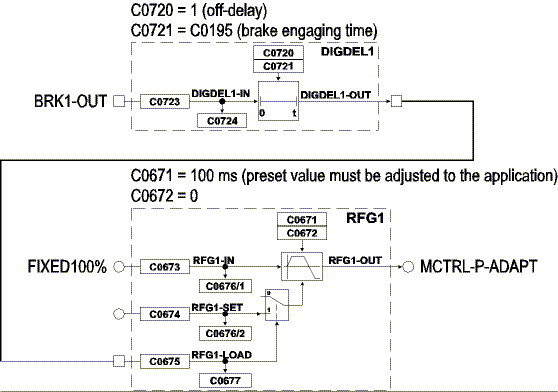
If these possibilities are not feasible because of inferior control properties, the configuration shown on the diagram should be selected. After brake closing time has elapsed (set in DIGDEL1) the influence of the angle controller is switched off via RFG1. The latter is only switched back on again at a ramp if the brake has disengaged. This can be at 100 ms by default but it must be adjusted to the application. With this configuration the following error is 'masked out', so to speak, for the time of torque feedforward control.