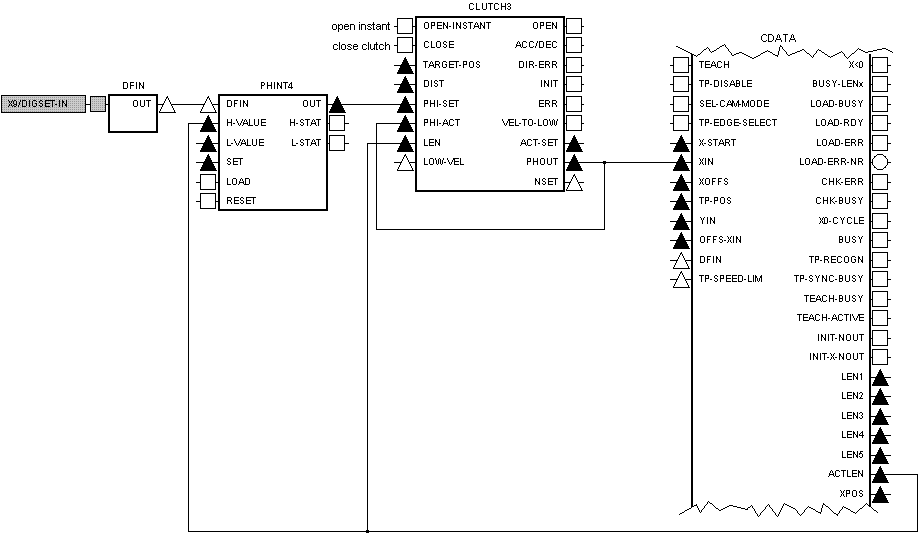
CLUTCH3: Connection example

Question:
How can the master value coupling (function block CLUTCH3) be integrated in the signal flow for an electronic cam in order to ensure the position-true coupling/decoupling to master value?

Answer:
Case 1 – Operation with master speed (e. g. via master frequency input DFIN):
Since the coupling block CLUTCH3 operates on position base, the x-position is to be generated before the coupling function is activated. As shown below the x-position can be generated via function block PHINT4. Consider that at the input PHINT4-HI-LIM the x-clocking time requires feedback from the function block CDATA.
The output PHINT4-OUT serves as a setpoint position for the coupling block (CLUTCH3-PHI-SET). The output of the coupling block CLUTCH3-PHOUT requires feedback to the actual position CLUTCH3-PHI-ACT. The output CLUTCH3-PHOUT also serves as master position for the function block CDATA and is connected correspondingly to the input CDATA-XIN.
Note: This function block switching should only be used when the master clocking time shows no decimal code!

Case 2 – Operation with master position (e. g. via CAN bus):
In this case the master value is not required to be generated via function block PHINT4, since a master position already exists as a master position. Connect this setpoint position to the input CLUTCH3-PHI-SET. The rest of the signal connection can be copied from case 1.

For both cases in function block CDATA the positioning input CDATA-XIN has to be selected as master value source (C1332/000 = 1). Continue to enter function blocks CLUTCH3 and for case 1 additionally PHINT4 in the processing list before function block CDATA.

URL for linking this AKB article: https://www.lenze.com/en-de/go/akb/200707330/1/
Contact form