Rising energy costs, stricter regulatory requirements, and ambitious sustainability goals are bringing the energy efficiency of machines and systems increasingly into focus. Since electric drives account for the majority of energy consumption in many applications, choosing the right motor efficiency class plays a key role.
But what do the designations IE1 through IE6 actually mean? What are the differences between the individual efficiency classes? And why are modern machine builders increasingly considering the entire drive system rather than just the motor?
What Are Motor Efficiency Classes?
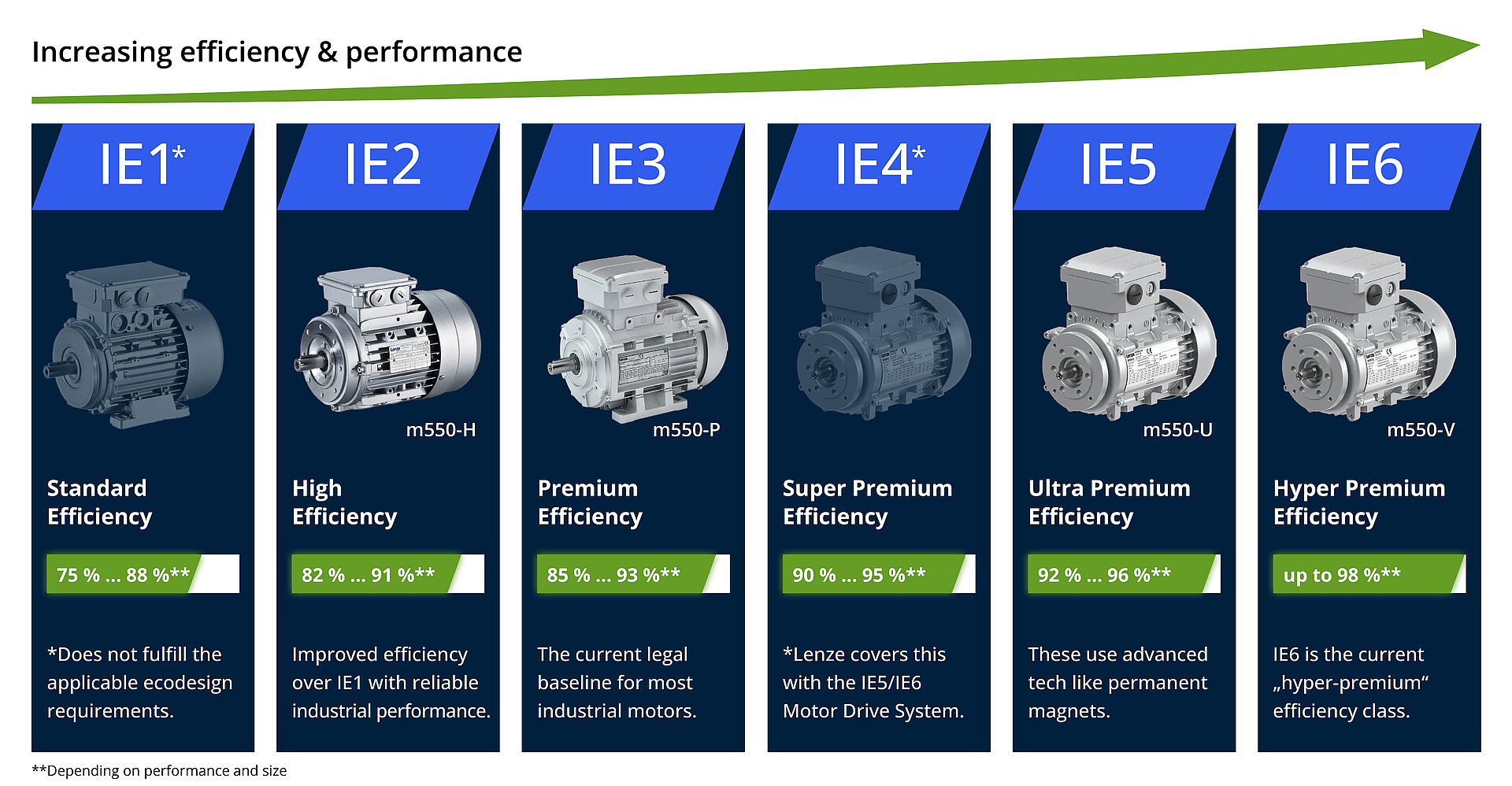
Motor efficiency classes describe the energy efficiency of an electric motor. The classification is based on international standards and is designated by the abbreviation IE (International Efficiency).
The higher the IE class, the lower the energy losses during operation. Higher efficiency means that a larger proportion of the electrical energy consumed is converted into usable mechanical power. This reduces power consumption, operating costs, heat losses, and CO₂ emissions.
At the same time, the sustainability and cost-effectiveness of machines and systems increase.
IE1: Standard efficiency
The IE1 efficiency class represents the lowest internationally defined efficiency class.
Motors in this class were the industry standard for many years. However, due to their comparatively high losses, they are now used in new installations only in exceptional cases.
Features:
- low energy efficiency
- high heat loss
- low purchase cost
- hardly relevant for new projects anymore
IE1 plays virtually no role anymore in modern machine designs.
IE2: High efficiency
IE2 marked the first major step toward improving energy efficiency.
Compared to IE1, these motors already exhibit significantly lower losses and were the standard in many industrial applications for a long time.
Features:
- Improved efficiency
- Lower operating costs
- Higher energy efficiency than IE1
- Still commonly found in existing systems
However, due to stricter regulatory requirements, IE2 motors are increasingly being replaced by more efficient alternatives.
IE3: Premium efficiency
IE3 is now considered the established industry standard in many applications.
Motors in this class offer a good balance between capital costs and energy savings.
Features:
- Significantly improved efficiency
- Cost-effective solution for many applications
- Widespread availability
- A common choice in mechanical and plant engineering
Notable energy savings can be achieved compared to older motor generations, particularly in continuously operating machinery.
IE4: Super premium efficiency
IE4 marks the beginning of the range of highly efficient motor technologies.
These motors achieve significantly higher efficiency levels and are used particularly in applications where energy consumption is a critical cost factor.
Features:
- Very high energy efficiency
- Lower power loss
- Reduced heat generation
- Attractive for energy-intensive processes
The higher initial costs are often recouped through the energy cost savings.
IE5: Ultra premium efficiency
IE5 marks a major technological leap in drive technology.
Modern synchronous motors with permanent magnets are frequently used here, achieving significantly higher efficiency levels than conventional asynchronous motors.
Features:
- Extremely high energy efficiency
- Particularly efficient during partial-load operation
- Lower operating costs over the entire service life
- Significant reduction in the carbon footprint
The major advantage is particularly evident in applications that run for many hours a day. In such cases, even small improvements in efficiency have a significant impact on energy consumption.
IE6: The next level of energy efficiency
IE6 currently represents the highest efficiency class for industrial drive systems.
The goal of this motor efficiency class is to minimize energy losses while enabling high dynamics.
Features:
- Highest available energy efficiency
- Maximum reduction of losses
- Ideal for sustainable production concepts
- Prepared for future regulatory requirements
IE6 solutions are becoming increasingly important, especially in light of rising electricity prices and ambitious climate goals.
Infobox: Why the motor alone isn’t the deciding factor
When evaluating energy efficiency, the focus is often on the motor’s efficiency. In reality, however, a machine’s energy consumption is not determined by a single component, but rather by the interaction of the entire drive train.
In addition to the motor, the gearbox, the VFD, the control software, and the control strategy used all influence the efficiency of an application. Each of these components either causes losses or helps to optimize energy use. Even a motor in the highest efficiency class cannot realize its full savings potential if the other components are not optimally coordinated with one another.
Intelligent coordination of all components plays a crucial role, particularly in applications with variable loads, frequent start-stop cycles, or long operating times. Modern VFDs, for example, enable speed control tailored to demand, while intelligent control algorithms can minimize energy losses during partial-load operation. The selection of the appropriate gearbox also has a direct impact on a machine’s overall efficiency.
That is why machine builders and plant operators today are increasingly focusing on the complete drive system rather than individual components. Only through the holistic optimization of the motor, gearbox, drive, and software can maximum energy efficiency, low operating costs, and sustainable machine performance be achieved.


Future-proof drive systems with IE5 and IE6
This development clearly shows that the future lies not only in more efficient motors, but also in intelligently coordinated complete systems.
One example of this is Lenze’s IE5/IE6 Motor Drive System. The system combines the m550 synchronous motor, the g500 gear series, and the i550 motec VFD or i650 motec VFD into an integrated drive solution.
The components are optimally coordinated with one another and, according to Lenze, enable:
- Efficiency classes up to IE5/IE6
- Up to 60% reduction in motor losses
- Sensorless control
- Up to 300% overload torque from a standstill
- Simple commissioning with minimal parameterization effort
The system thus helps machine builders combine energy efficiency, cost-effectiveness, and performance.
Conclusion
From IE1 to IE6, a clear trend is evident: Energy efficiency requirements are continuously increasing. While IE3 is now standard in many applications, IE5 and IE6 systems are setting new benchmarks in terms of sustainability and operating costs.
For machine builders, it is becoming increasingly important not only to choose the right motor but also to optimize the entire powertrain. Anyone seeking to reduce energy consumption, CO₂ emissions, and operating costs in the long term will find it nearly impossible to do so without modern drive systems in the highest efficiency classes.