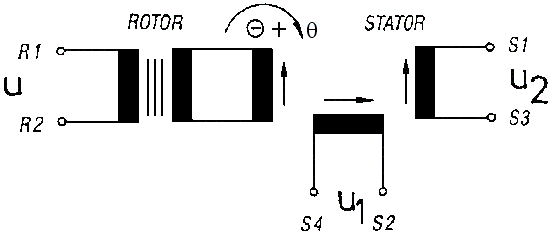
Resolver: Functional principle

Question:
How does a resolver work in principle?

Answer:
Resolvers work according to the induction principle. A sinusoidal alternating voltage is transmitted into the winding of the rotor, which is permanently connected to the motor shaft, by means of a transformer (therefore brushless). This induces the voltages u1 and u2, which depend on the rotor position angle, in the two stator windings, which are offset by 90°.
From the amplitude-modulated voltages u1 and u2, the rotor position angle and the angular speed can be determined as an actual speed value signal using downstream evaluation electronics.
The resolver therefore provides absolute angle information via a rotation angle of 360 ° / p  (p = number of pole pairs of the resolver).
Resolvers are therefore absolute encoders and suitable as feedback systems for synchronous motors, just as SinCos absolute encoders with Hiperface interface or other communication interfaces.

Depending on the feed point of the AC voltage, a distinction is made between the following resolver types:

  1. transmitter type:
    Supplying the rotor and evaluating the stator signals
    (see illustration below, e.g.: servo inverter ECS, 8400TL,  i750, i950)

  2. Receiver type:
    Supply of the stator windings with sine and cosine amplitude modulated signals and evaluation of the signal from the rotor
    (e.g.e.g.: servo controller 9300, 9400, i700)
The impedances of the rotor and stator windings can be significantly different for the two types.

Search terms: function, principle, mode of operation, concept

Coil systems of a resolver (schematic):

[Automatic Translation]
URL for linking this AKB article: https://www.lenze.com/en-de/go/akb/200411217/1/
Formulario de contacto