Motor excitation, preventing sagging during hoist application

Question:

When using an asynchronous machine on a servo inverter 9300 how can the rise behaviour be improved after controller enable?

Answer:

Depending on the size of motor the time up to complete remagnetisation of the motor can vary considerably. In the case of small motors (e.g. 2 kW) it is less than 200 ms whereas in the case of large motors (e.g. 100 kW) it can enter the seconds range. During remagnetisation the drive cannot provide any current which creates torque.

If a drive, e.g. in a hoist application, has to take on a load after release of the controller, that time must also be taken into consideration (e.g. delay in brake enable). If the brake is disengaged too early, it can cause undesirable load sagging.

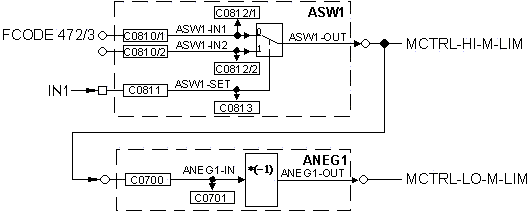
If the brake control is handled externally (e.g. from the PLC) and if the drive is to take on the load immediately, motor excitation must be maintained. This can be achieved with the following configuration, for example, but it assumes that the controller remains enabled (including terminal 28 = high). Via FB ASW1 there is a switchover between the torque limits for normal mode and torque limit '0 %'. The digital input can be activated both via the terminals and via bus interface modules. In this case the default setting of 100 % has been retained as the torque limit.

One must bear in mind that the drive is operating at maximum current when the torque limits are switched on again because the speed controller is then at its limit. Consequently, excessively frequent bringing on line can cause the rise in device utilisation to over 100% and thus to overload error OC5.

If alternatively FB BRK1 is used for brake control in the servo inverter (e.g. in C0005 = 1100), a delay can be brought about at brake output BRK-OUT by selecting a torque feedforward under C0244 and defining a brake opening time under C0196.

Notes about FB configuration (in the case of external brake control):
  • Since there is no signal source linked at ASW1-IN2, the value of 0% is automatically selected by the controller internally
  • FCODE472/3 = 100 % (factory setting)
  • IN1 = switching signal via digital input or AIF module


URL for linking this AKB article: https://www.lenze.com/en-de/go/akb/20020474/1/
Formulario de contacto