Intralogistics is at a turning point. Companies must meet rising demands for dynamism, energy efficiency, and flexibility – all in a world where digitalization and machine networking are increasing complexity. This is especially true for stacker cranes and conveyor systems: loads must be moved precisely and quickly without wasting energy. At the same time, pressure is growing to design systems that are scalable and modular.
A holistic concept combining high-performance hardware, modular software, and integrated engineering tools can provide a solution here. The focus is on preconfigured machine solutions for stacker cranes, a drive-based motion concept, and the i950 servo drive. The goal: maximum efficiency of stacker cranes with simple integration.
Modular Software Modules: FAST for storage and retrieval machines
A key factor for efficient stacker cranes is software that is reusable and proven in practice. This is where Lenze comes in with its FAST machine solutions (“Lenze Feasible Application Software Toolbox”). FAST provides pre-built standard modules—for example, for motion and positioning profiles, quick-stop functions, or manual operation. This allows frequently used motion functions to be implemented in a structured manner.
Additionally, specific functions that increase efficiency and protect the mechanics are particularly relevant for stacker cranes—e.g., anti-pendulum, load balancing, mast oscillation compensation, or profile synchronization. The FAST modules are based on IEC 61131-3 and—embedded in a customer-specific framework—map the motion functions of the stacker crane.
Shorter project timelines and changing market requirements mean that customers need ready-made motion control solutions that can be directly integrated into the customer’s control system. Lenze has therefore further developed its own framework (with logic functions and embedded FAST modules) for stacker cranes.
The Controller Based Motion (CbM) approach describes a higher-level, centralized motion control system. The advantage: With the exception of the standardized FAST modules, the solution is freely programmable in Lenze PLC Designer according to IEC 61131-3, expandable, and thus particularly flexible for complex and dynamic stacker cranes.
CbM is particularly suitable when:
- The scope of functions and dynamics are high, and individual adaptations are required.
- The focus is on expandability and customer-specific logic.
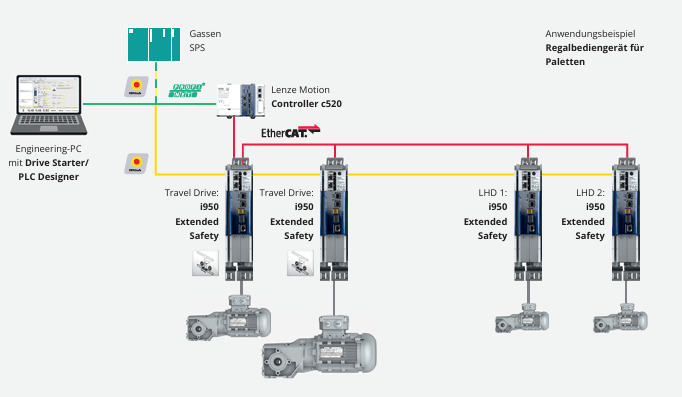
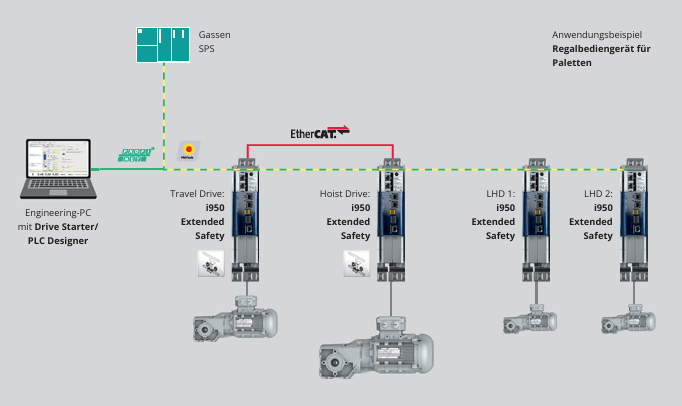
In practice, many users prefer a less flexible but technically simpler solution that can be commissioned more quickly. Thanks to the increased computing power of the i950, a Drive-Based Motion (DbM) solution is possible that no longer requires an external controller.
DbM reduces installation space and cabling effort, yet still offers the full range of functions of the CbM solution. At the same time, it includes the integration of the safety technology of the i950 servo drive series.
Important: DbM is designed as a closed-loop technology application and cannot be modified by the customer. However, it can be easily parameterized using the Lenze EASY Starter—significantly reducing the commissioning time for storage and retrieval machines. The mapping of control and status data to the higher-level controller remains freely configurable, supporting seamless integration into existing systems.
DbM is particularly suitable when:
- Commissioning time and easy installation are the top priorities.
- Modernizations or control retrofits of storage and retrieval machines are planned
Energy Efficiency & System Integration: DC Bus and Energy Recovery as Leverage
Energy efficiency remains a key priority—both for cost reasons and in the context of regulatory requirements and sustainability goals. The i950 DC-Link, which will be available in the future, reduces energy exchange between the axes via the DC bus, thereby lowering energy consumption and simplifying the power supply concept.
Excess energy can be fed back into the plant grid via the energy recovery unit—with the goal of significant energy and cost savings. Optimized control algorithms support maximum energy efficiency and dynamics, particularly for stacker cranes and complex material flow systems.
Conclusion: The right architecture for every storage and retrieval machine strategy
Whether maximum flexibility or maximum speed: Both motion concepts are designed as future-proof technologies and pave the way for efficient, flexible warehouse technology. CbM provides the framework for complex, dynamic solutions with a high degree of customization. DbM excels where fast installation and short commissioning times are crucial—especially during retrofits.
To achieve this, Lenze combines modular software, high-performance hardware, and system integration into a comprehensive solution—ensuring that machine builders gain the efficiency and flexibility they need for digital transformation and sustainable production.