
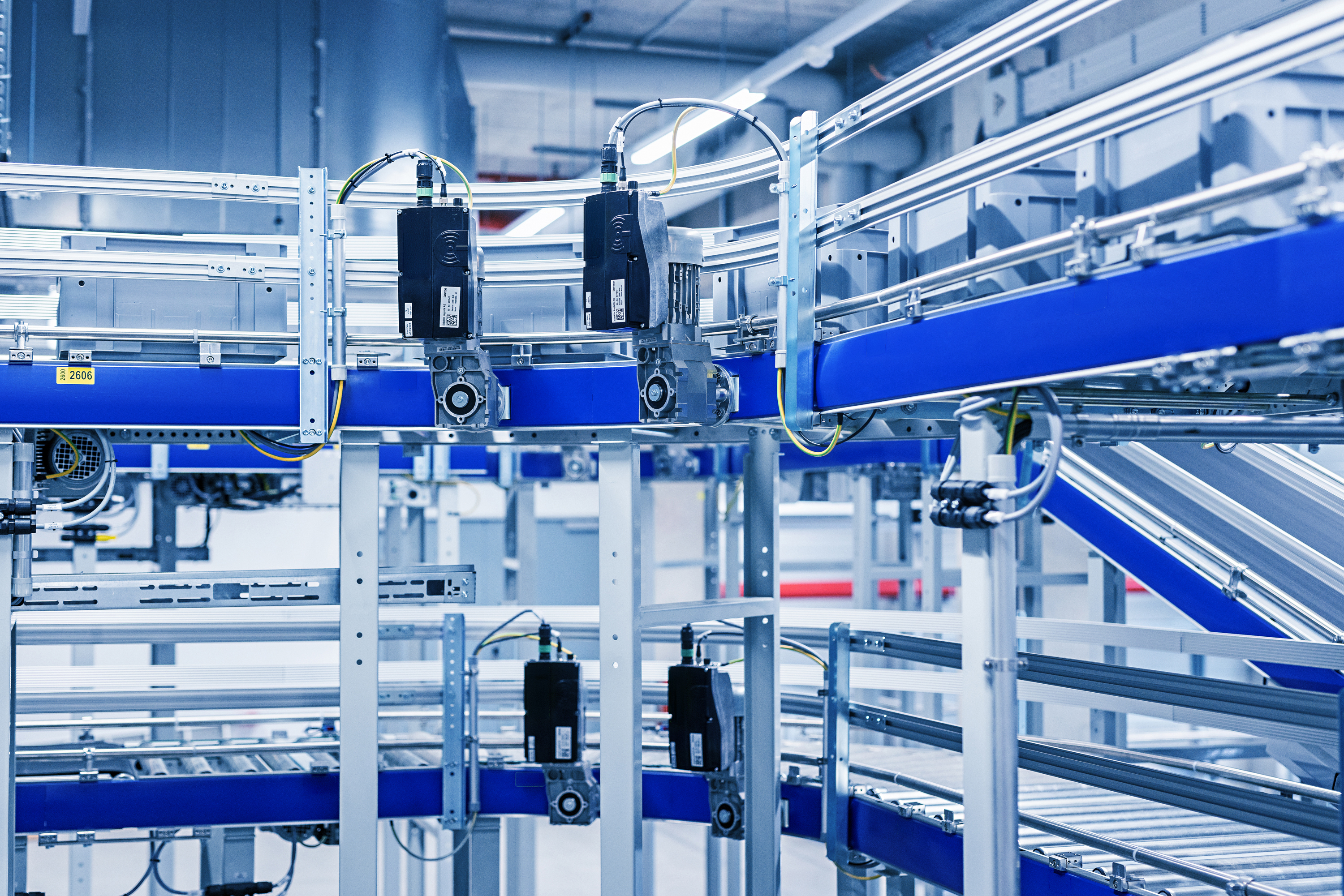
Fewer variants. Less complexity. Greater efficiency in engineering, procurement, and service.
The Lenze Smart Motor m300 was developed to meet the requirements of modern horizontal materials handling technology. It helps machine builders and materials handling technology manufacturers standardize drive concepts, simplify commissioning, and reduce effort throughout the entire life cycle.
The solution is suitable for many recurring conveying tasks, ranging from roller and belt conveyors to chain conveyors, corner transfer units, and cross-transfer cars.
Calculate Potential Savings Discuss the application with Lenze

Benefits for your materials handling technology
-
Reduce variants
High overload capacity and a standardized drive concept help to handle a variety of conveying tasks with fewer drive variants.
-
Simplifying engineering
Standardized design, wireless parameterization, and reusable concepts reduce the effort required for planning and commissioning.
-
Streamlining procurement and inventory management
Fewer variants simplify ordering processes, reduce inventory levels, and support a clearer spare parts strategy.
-
Speed Up Service
NFC configuration without a voltage supply simplifies commissioning, device replacement, and field work.
How does the Lenze Smart Motor m300 simplify horizontal materials handling technology?
The Lenze Smart Motor m300 combines a motor and electronic speed control into a standardized drive concept for horizontal materials handling technology. Its high overload capacity can reduce the number of drive variants required. Parameterization is performed wirelessly via NFC using a smartphone or PC, without the motor needing to be subjected to voltage or addressed.
This reduces the effort required for engineering, procurement, commissioning, inventory management, and service. The concept is used in roller, belt, and chain conveyors, as well as in corner transfer units and cross-transfer cars.
When is the Lenze Smart Motor a good fit for your materials handling technology?
The greatest benefits are realized when numerous drives, recurring conveyor modules, and a wide variety of configurations come together. Review the following criteria before proceeding with the technical design.
-
Many recurring drive tasks
Your system consists of standardizable conveyor modules with similar speed and torque requirements. -
Frequent start-stop cycles
The conveying task requires short cycle times and a high number of switching cycles. -
High variant and process complexity
Engineering, purchasing, warehousing, and service are burdened by numerous motor and gear variant options. -
Decentralized, simple commissioning
Parameterization directly on the motor and without a voltage supply is intended to reduce effort in the field. -
Scalable machine platform
The drive concept is intended to be reused across projects, line variants, and operating environments.
Potential Savings with the Smart Conveyo Check Technical Suitability


The most important criteria for preselection
Criterion | Suitability note | Required for design |
Conveyor type | Suitable for typical horizontal roller, belt, and chain conveyors as well as transfer conveyors. | Mechanics, ratio, and motion profile |
Load and conveyed material | From standard materials to approved heavy-duty applications. | Mass, Friction, Incline, Acceleration |
Cycle time and start-stop operation | Particularly relevant for frequent starts, stops, and short cycle times. | Cycle, duty cycle, thermal load |
Number of drives | Standardization potential typically increases with the number of drives and the degree of repetition. | Drives per module, modules per system, projects per year |
Speed and overload | Electronic speed control and high overload capacity support the reduction of variants. | Speed range, rated and peak torque, overload duration |
Environment | Can be used in normal, refrigerated, and frozen environments. | Temperature, degree of protection, humidity, cleaning requirements |
Communication and parameterization | NFC supports local wireless parameterization without a voltage supply. | Operation and Service Processes, Data Backup |
Safety and standards | Evaluate the machine safety concept separately. | Risk assessment, required safety functions, system limits |
Energy and cost-effectiveness | Consider the overall impact of variants, components, the control cabinet, engineering, and operation. | Basis for comparison, project scope, operating hours, energy price |
The table aids in the preliminary selection but does not replace a technical design. The final selection depends, among other factors, on the load profile, gearbox, ratio, environmental conditions, duty cycle, and safety concept.
Reducing the variety of options in materials handling technology
The growing variety of variants increases the workload in engineering, procurement, warehousing, and service. The Lenze Smart Motor m300 was developed to reduce this complexity and provide a standardized drive concept for horizontal materials handling technology.
High overload capacity and electronic speed control make it possible to cover multiple operating points with fewer mechanical and electrical variants. This facilitates reuse across conveyor modules, system variants, and follow-up projects.
Benefits at a glance
- Fewer drive variants
- Simplified drive design
- Greater reusability across machine variants
- Reduced inventory of bearings and spare parts
- Clearer standards for engineering and service

Easy installation. Quick setup.
Easy installation. Quick commissioning.
Parameterization is performed via NFC directly from a smartphone or PC. The motor does not need to be powered on with voltage, addressing is not required, and the terminal box does not need to be opened. This reduces the number of steps required during commissioning and service.
Procedure
1. Prepare parameters: Select theappropriate parameter set in the Smart Motor app or on a PC.
2. Transfer wirelessly: Transferthe parameters to the de-energized Smart Motor via NFC.
3. Check mechanics and function: Validatethe direction of rotation , speed, load behavior, and protection concept on the system.
4. Save the parameter set: Document theapproved configuration for reuse and service.
Benefits at a glance
- NFC-Based Parameterization
- Parameterization without a voltage supply
- No addressing required
- No need to open the terminal box
- Quick commissioning and high flexibility in field service

Reducing complexity throughout the entire life cycle
Engineering and commissioning
- Less engineering effort
- Simplified drive design
- Faster NFC parameterization
- Reusable machine standards
- Reduced control cabinet and control system complexity, depending on the comparison concept
Purchasing, Logistics, and Service
- Fewer Variants to Procure
- Reduced inventory levels
- Simplified spare parts management
- Simpler field service processes
- Lower process complexity across project variants
From planning to operation:
the right tools
-
Smart Conveyor Calculator
The Smart Conveyor Calculator identifies potential savings for a specific materials handling technology application. Among other factors, it takes into account the existing motor control system, conveyor length, number of conveyor modules, cable length, and annual project volume.
-
EASY System Designer
The EASY System Designer assists in the design of the drive solution and links the initial preselection to specific system data.
-
Lenze Smart Motor App
The Lenze Smart Motor App supports NFC-based parameterization and simplifies commissioning and service directly at the installation site.
Want to quickly calculate your potential savings? Smart Conveyor Calculator …
In just a few steps, the Smart Conveyor Calculator shows how materials handling technology projects can be optimized economically through the use of the Lenze Smart Motor.
Proven in horizontal materials handling technology
The Lenze Smart Motor m300 is in use in more than 250,000 installations. Its range of applications extends from traditional materials handling technology to approved heavy-duty applications handling loads of up to 6.8 metric tons, as well as applications in standard, refrigerated, and frozen storage environments.
Explore your potential with experts now
Are you looking to reduce the number of variants, develop a new concept for materials handling technology, or optimize an existing system for greater efficiency? Our experts will support you every step of the way—from the initial assessment through design to the implementation of the right drive concept.
Frequently asked questions about horizontal materials handling technology with the Smart Motor m300
How does a standardized drive concept support the scaling of materials handling technology projects?
By reducing the number of variants, engineering, procurement, and service can be standardized across various materials handling technology projects. This simplifies planning, reduces inventory levels, and supports the efficient growth of standardized machine platforms.
When is it particularly worthwhile to use a smart motor?
The Smart Motor offers particular advantages in materials handling technology applications with many installed motors, frequent start-stop cycles, and recurring machine designs. Generally, the greater the variety of models and the number of motors used, the greater the potential for standardization.
For which types of conveyors is this solution suitable?
Typical applications include roller conveyors, belt conveyors, chain conveyors, corner transfer units, and cross-transfer cars. Suitability is determined based on load, speed, cycle time, gearbox, environment, and overload profile.
Can the Smart Motor be used in refrigeration and freezing applications?
Yes. The Smart Motor is used in materials handling technology applications in the standard, fresh, and frozen food sectors, where it supports a unified drive concept across various application areas.
How does NFC-based parameter configuration work?
Parameters are transmitted wirelessly to the Smart Motor via a smartphone or PC. The motor does not need to be powered by voltage; addressing and opening the terminal box are not required.
Does the calculator replace the technical design?
No. The calculator highlights economic potential and helps with initial planning. The technical design must take into account the load profile, mechanical components, gearbox, environmental conditions, and the protection and safety concept.