IE5/IE6 Motor Drive System for Sensorless Servo-Light Performance
Sensorless performance combined with energy efficiency and cost-effectiveness
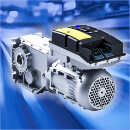
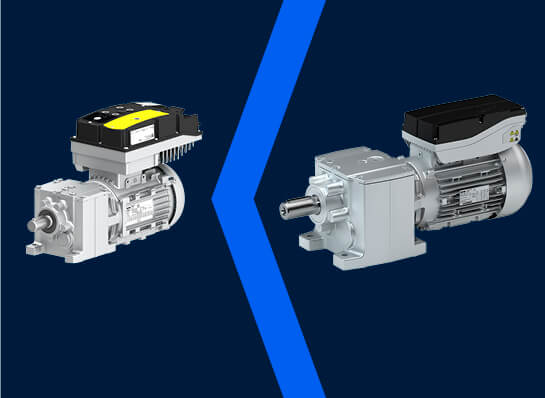
More dynamics, less complexity: The IE5/IE6 Motor Drive System offers machine builders a new way to solve simple servo-like motion tasks more cost-effectively. As a coordinated system solution consisting of the m550 permanent synchronous motor, the g500 gearhead, and Lenze drive technology, it combines sensorless performance, high IE5/IE6 energy efficiency, and easy integration.
Many applications today require more than just speed control—but not always a full-fledged servo architecture. This is exactly where the IE5/IE6 Motor Drive System comes in: It enables reproducible positioning, dynamic starting and stopping, and stable performance under varying loads—without external encoders and with significantly reduced system complexity.

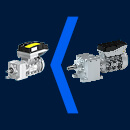





An overview of the benefits of the IE5/IE6 Motor Drive System
The IE5/IE6 Motor Drive System is not intended as a loose combination of individual components, but rather as an integrated system solution. The optimized interaction between our m550 permanent synchronous motor, g500 gearbox (helical, bevel, or bevel gearbox), and our frequency and servo drives increases efficiency while reducing interfaces and system complexity. This reduces engineering effort and speeds up integration and commissioning.
| Integrated system solution consisting of a motor, gearbox, and drive | Servo-light instead of servo complexity: Implement servo-like motion tasks—such as positioning, synchronization, dynamic start-stop cycles, and torque control—without sensors | |
| Motor performance data: 0.25 to 22 kW | Drive Performance Data: 0.25 to 250 kW | Gearbox Performance Data: 45 to 4,500 Nm |
| Constant, load-independent speed accuracy | Top performance in sensorless operation with Lenze drives | Optimal interaction of all components for maximum efficiency |
| Reduced interfaces and lower system complexity | When used with the motec series: Integrated 4-port IO-Link master for easy sensor connection | Consistent system logic for faster integration and commissioning |
| Already prepared today to meet the requirements of the Cyber Resilience Act (CRA) and future efficiency requirements | Market approvals for Europe (CE), North and South America (cULus), and Asia (CCC/CEL) enable the global use of the IE5/IE6 Motor Drive System. | |
Sensorless positioning, reducing servo complexity
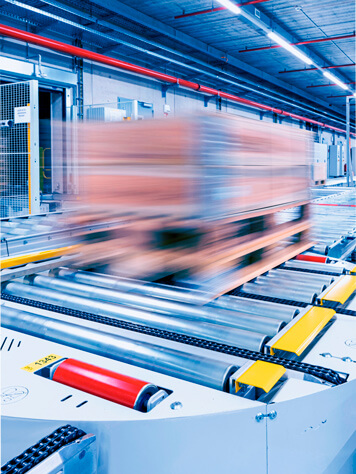
Many machine applications require precise, repeatable motion—but not always the full complexity of a traditional servo axis. This is exactly where the IE5/IE6 Motor Drive System comes in: It enables servo-like motion tasks such as relative positioning, dynamic acceleration, and stable performance under varying loads—without sensors or external encoders. Where traditional feedback-based systems require additional hardware, cabling, and integration effort, the IE5/IE6 Motor Drive System combines repeatable positioning with a significantly simpler system architecture. This allows you to achieve the required motion quality with fewer components, less engineering effort, and handling that is as simple as that of an asynchronous motor.

Your benefits of sensorless positioning:
- Repeatable positioning without external encoders
- Servo-like performance for simple positioning and motion tasks
- Sensorless operation thanks to the SLSM algorithm
- No expensive motor feedback systems required
- Reduction in the number of drive variants
- Less additional hardware
- Reduced Cabling
- Simplified design and commissioning
- Cost-effective operation thanks to reduced system costs
Less engineering effort, faster integration
In mechanical engineering, the complexity of a drive system is often determined not during operation, but already during the planning and integration phases. Every additional interface, every wiring step, and every separate sensor integration increases complexity, the potential for errors, and the time required. Fewer variants improve standardization. A system-oriented approach to drive design reduces these bottlenecks and ensures that engineering resources can be allocated more effectively to the actual machine function.
This reduces the workload for engineering and commissioning:
- Faster integration into the machine
- Shorter commissioning times
- Less installation and wiring work
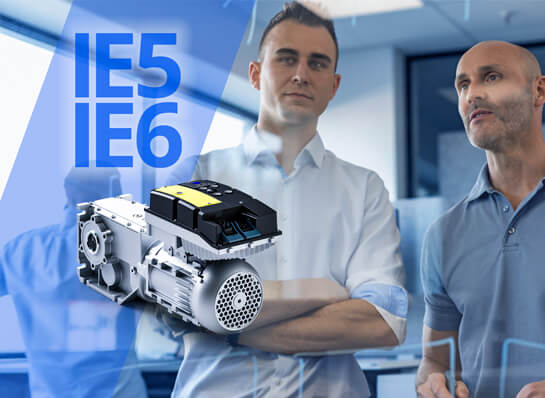
Dynamic applications are characterized by short load peaks, dynamic transitions, high overload capacity, and the ability to reliably handle changing operating conditions. In such cases, the focus is not only on efficiency, but also on reserve capacity, control behavior, and process stability. The sensorless IE5/IE6 Motor Drive System addresses precisely these requirements and helps make dynamic applications controllable and cost-effective.
Your benefits for dynamic applications:
- High overload capacity of up to 300%
- Reliable management of peak loads
- Available starting at 0/rpm
- High control performance without adding to system complexity
- Rapid acceleration and deceleration
- Consistent performance even under varying loads
- Precise sizing instead of unnecessary oversizing

Whether a drive system is cost-effective is usually determined not at the rated point but during the machine’s day-to-day operation. Especially in applications with long running times, varying load conditions, and frequent operation below the rated point, the system’s efficiency under real-world conditions is crucial. The IE5/IE6 Motor Drive System is designed precisely to meet these practical requirements and helps machine builders achieve efficiency not just in theory, but in actual operation.
Operational efficiency benefits:
- Efficiency ratings up to IE5 and IE6 (IEC TS 60034-30-2) or Grade 1 (GB300253-2024)
- Maximum efficiency even under deep partial-load conditions
- Significantly reduced motor and system losses
- Integrated energy recovery without a braking resistor (in combination with motec)
- Reduced energy consumption for lower operating costs
- Supports cost-effective and sustainable machine designs
Where do conveyor systems really waste energy?
Joint measurements in real-world facilities show that, with belt conveyors, the greatest efficiency losses often occur where you least expect them. Lenze and Forbo took a closer look—and demonstrated how energy consumption can be reduced by up to 40% through lower friction and a demand-oriented design of the drive systems.
Download the white paper now and learn how to make conveyor systems more efficient, sustainable, and cost-effective.
High efficiency without a significant increase in size
Those looking to improve energy efficiency and performance do not necessarily want to settle for larger machine designs. This is exactly where the IE5/IE6 Motor Drive System comes in: It offers machine builders improved energy efficiency without placing an unnecessary burden on existing designs. This facilitates integration into machines and systems with limited installation space, as well as the development of new, compact machine designs.
Your design benefits:
- IE5/IE6 efficiency in a compact design—increased efficiency without design changes
- Space savings of up to two sizes compared to IE3
- Reduced installation space by omitting the encoder
- Compact design featuring a g500 gearbox and an IE5/IE6 motor
- Space-saving integration with improved performance and system efficiency
The system’s high energy efficiency also makes a significant contribution to reducing energy consumption and the carbon footprint, depending on the application and utilization rate. In addition, the use of energy-efficient products may be eligible for government subsidies, depending on the country and local conditions.
The economic advantage lies not only in the component price, but in the system as a whole: fewer encoders, less specialized cabling, less hardware, less integration effort, and reduced complexity in commissioning and service. This makes the IE5/IE6 Motor Drive System a cost-effective alternative for servo-like applications where a complete servo system is not technically necessary.
However, factors such as energy consumption, maintenance requirements, and operational reliability are also crucial in determining how reliably the system will perform over the years. The IE5/IE6 Motor Drive System is designed to reduce precisely these operating costs, thereby sustainably improving the total cost of ownership.
Life cycle benefits at a glance:
- Low energy consumption over the entire service life
- Reduced operating costs thanks to high efficiency, even at partial load
- Less hardware, cabling, and integration effort
- Low-maintenance and reliable operation
- High process stability even under varying loads
- High process stability even under varying loads


The quality of a drive solution is often determined as early as the design phase. The more clearly efficiency, performance, and cost-effectiveness can be assessed in advance, the more reliable design and investment decisions become. That is precisely why a transparent design process is not just a technical step, but a key factor in making faster and more informed project decisions.
The EASY System Designer supports fast and precise planning, from individual axes to complex machine solutions.
Typical applications
Many machine applications today require more than just speed control—but not always a full-fledged servo architecture: The IE5/IE6 Motor Drive System is suitable for servo-like motion tasks such as positioning, synchronization, dynamic starting and stopping, or the reliable control of varying loads—with sensorless performance and significantly reduced system complexity.